



TLDR: Markets ignore a major oil shock and soar on AI. Our take: active neutrality on equities, overweight on metals and Euro Investment Grade credit, profit-taking on technology—and increased vigilance on the debt now financing the AI boom.
Our one-page take
BNP Paribas Wealth Management’s June 2026 strategic guidance note describes a paradox we share: nearly 14% of global oil production has been interrupted since early March, yet the MSCI All Country World index has risen 6% over three months, including a 14% rebound from its late March low [1]. Where the note stops at observation, we add the missing piece to the puzzle: this cycle is increasingly debt-financed, and that’s where future yield and risk lie. Our role at Neumarz is not to relay a bank’s view—it’s to confront it with market facts and derive allocation decisions.
What we take away, from our perspective:
- AI drives indices, but concentration and leverage have never been higher—a bull market to monitor, not to endure.
- The Strait of Hormuz shock remains an underestimated stagflation risk: we remain Neutral on equities and strengthen convexity.
- Metals (copper, aluminum, gold) are the conviction most corroborated by third-party sources.
- The ECB/BoE vs. Fed divergence is moderately favorable to the Euro; Euro Investment Grade credit offers the best entry point.
- On tech and emerging markets, we are taking partial profits—discipline, not a bearish conviction.
AI boosts indices—but is now debt-financed
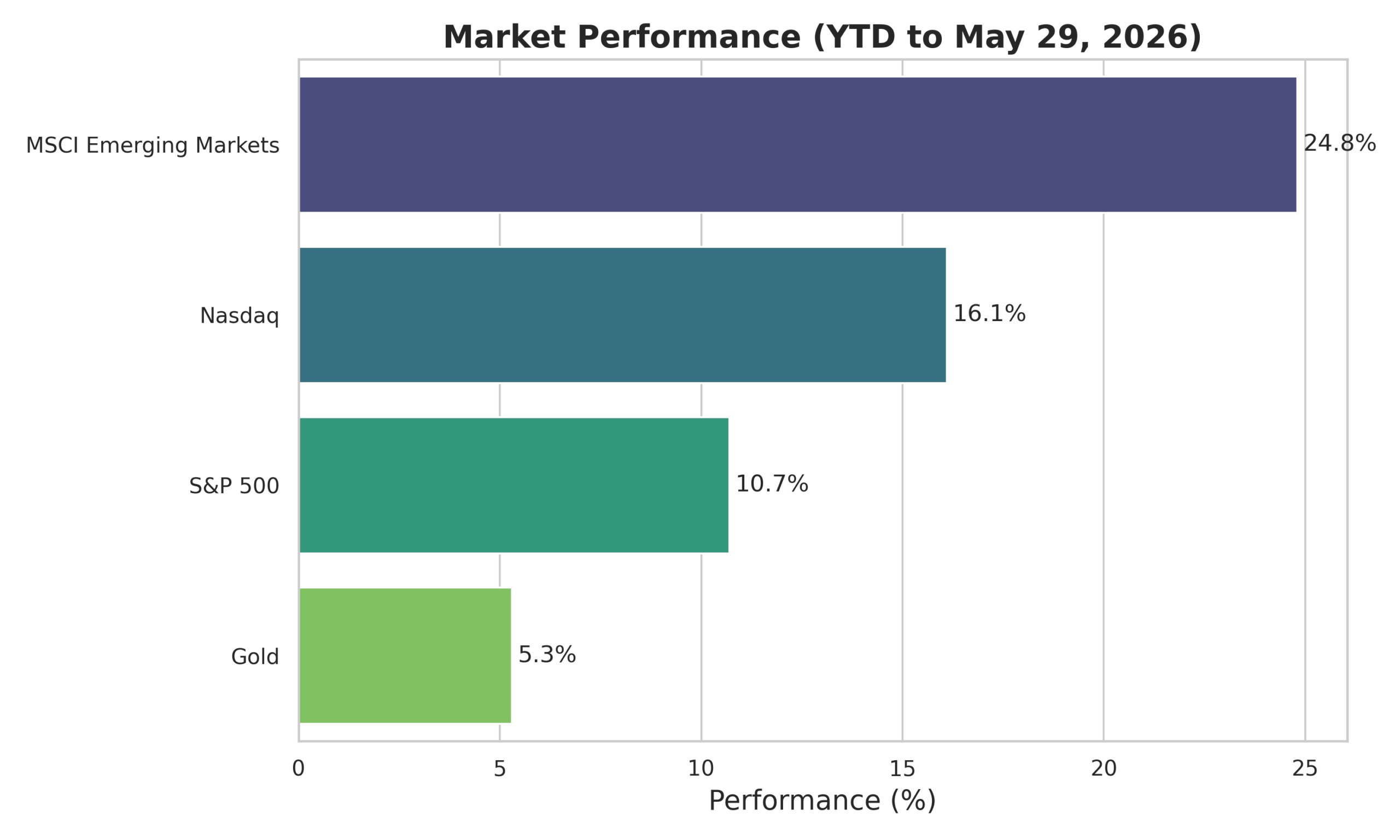
First-quarter earnings season was strong in the United States, driven by the AI investment boom [1]. The Nasdaq 100 has risen 21% year-to-date, and the semiconductor sector has gained 66% since the end of 2025. Earnings are following: S&P 500 2026 forecasts have been raised by 8.5%, for an expected EPS (earnings per share) growth of 16% [1].
Performance of markets since January 1, 2026
The proof by debt: what the note doesn’t say loudly enough
The financing structure tells the real story. U.S. technology companies have raised $159 billion in the bond market this year [1]. More importantly, a factual correction is needed on a point that was quickly picked up: the $80 billion fundraising announced by Alphabet (Google) in early June 2026 is a stock issuance, not a bond issuance—since raised to $84.75 billion, including $10 billion subscribed by Berkshire Hathaway—to finance an estimated 2026 capex of $180 to $190 billion [2]. At the sector level, Alphabet, Microsoft, Amazon, and Meta are expected to dedicate nearly $800 billion to AI in 2026 [3].
Our added value lies in the signals we cross-reference in real-time, confirming the shift towards leverage:
- Amazon secured a $17.5 billion term loan for its AI infrastructure, bringing its debt beyond $225 billion [6].
- Cipher Digital raised $810 million via high-yield bonds (junk bonds) to complete a data center leased to Amazon in Texas [7]—AI financed by speculative credit, at the asset level.
- A wave of IPOs estimated at $3.6 trillion (SpaceX, OpenAI, etc.) is preparing, a classic signal of a cycle end [8].
Neumarz’s conclusion: AI is no longer financed solely by excess cash and is becoming a leveraged asset, sensitive to the cost of capital. We treat technology credit as a standalone exposure, distinct from the equity pocket, and we spread AI exposure beyond semiconductors—electrical equipment, networks, construction—to capture the thesis without suffering concentration (the May ISM Manufacturing PMI, at 54.0, confirms diffusion into the real economy) [1].
The Strait of Hormuz oil shock: an underestimated stagflation risk
As of June 5, no agreement has been reached between the United States and Iran, and the Strait of Hormuz remains closed [1]. The closure deprives importers of approximately 10 million barrels per day, nearly 10% of daily demand; strategic reserves (United States, China, Japan) cushion the deficit but are expected to reach critical levels by the end of June without reopening. Spot Brent has held above $90 ($93 on May 29), with “dated cash” rising to $115 [1].
Inflation is spreading: in the United States, diesel has risen from $3.70 to $5.60 per gallon, core CPI (Consumer Price Index) is at 3.8%, and producer prices excluding energy (PPI) are at 5.2%, while the Eurozone remains at 2.2% [1]. Our take: this is a risk of partial stagflation, the most uncomfortable scenario for central banks. We remain Neutral on equities—active neutrality: maintain exposure but strengthen convexity (hedges, safe havens, liquidity) and favor companies with real pricing power. Regionally: underweight the Eurozone, Neutral on the United States, Japan, and emerging markets, with a preference for oil exporters (Latin America).
Metals: our most corroborated conviction
Demand for technology and defense, combined with Gulf disruptions, supports aluminum and copper, which are near their annual highs [1]. This is the conviction most clearly validated by independent sources, making it our preferred overweight:
- S&P Global anticipates a structural deficit in copper supply, driven by AI, data centers, and defense [4].
- On prices, J.P. Morgan targets copper around $12,500 per ton in Q2 2026 and Bank of America aluminum near $3,000 per ton in Q4—consistent with constrained supply.
- For gold, the opinion remains Positive (target raised to $5,500 per ounce, silver to $90) [1]; a record of $5,589 was reached on January 28, 2026, and J.P. Morgan sees gold pushing towards $6,000 by the end of 2026 [5].
We favor diversified European mining companies (exposure to the theme coupled with dividends and stricter capital discipline than in the previous cycle) and treat gold as structural macro insurance, not a directional bet.
Rates and currencies: the Euro and IG credit as an entry point
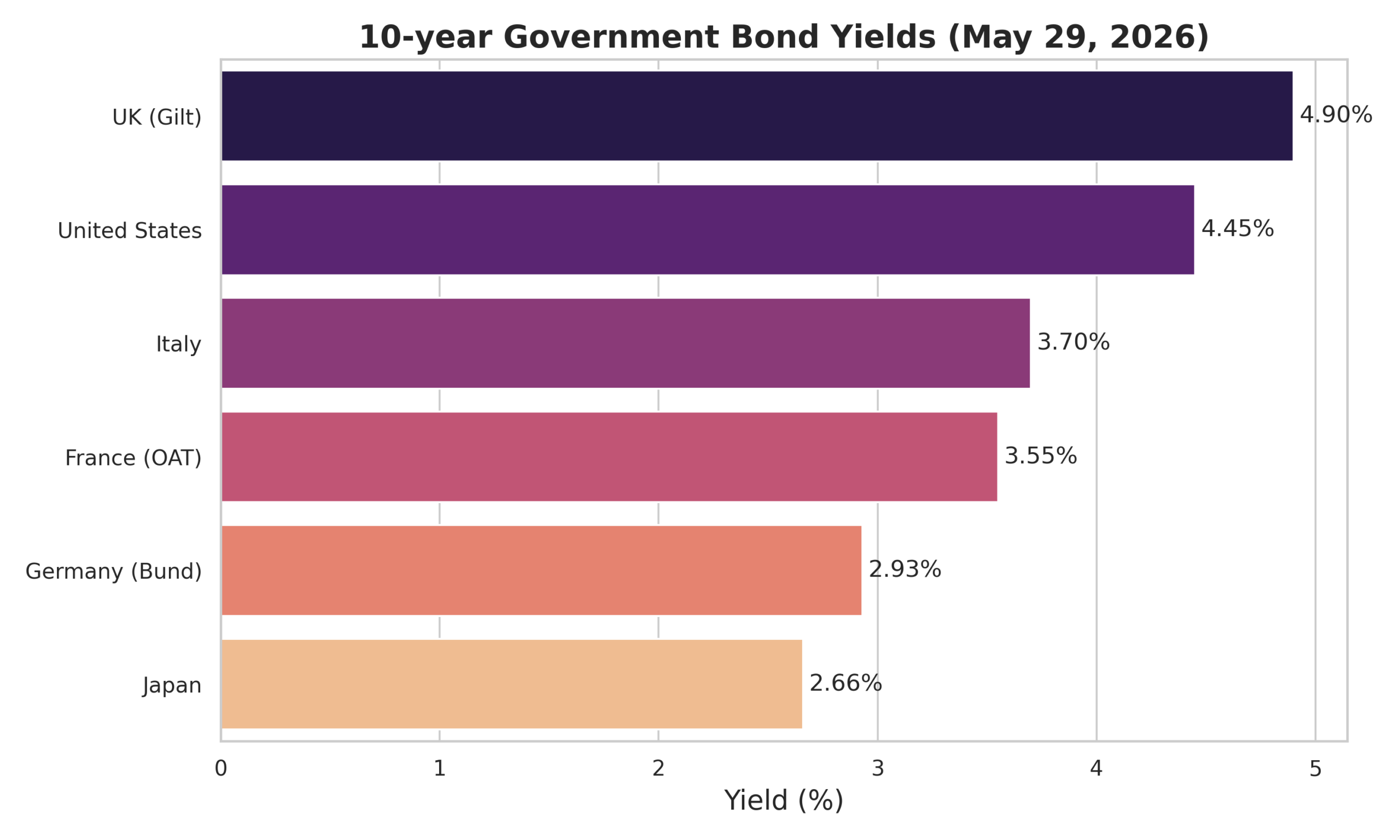
Energy tensions are expected to push the European Central Bank (ECB) and the Bank of England to raise their rates once this year, while we anticipate stability in Fed Funds—a moderately favorable configuration for the Euro (12-month EUR/USD target at 1.20, compared to 1.1661 on May 29) [1]. 10-year yields have risen: 4.5% in the United States, 3.0% in the Eurozone, 2.7% in Japan, with UK gilts nearing 5.2% before retreating to 4.9% amid political risk [1].
10-year Government Bond Yields (May 29, 2026)
Higher rates weigh on valuations, especially U.S. ones. Our positioning: Positive on core Eurozone sovereigns (7-10 years), Neutral on U.S. Treasuries (~5 years). Crucially, the rise in yields has reopened an entry point for Investment Grade (IG) credit—3.6% in Europe, 5.2% in the United States [1]: we favor IG in Euros and Pounds (Positive) over Dollars (Neutral), with an emphasis on quality. High Yield, however, remains sidelined: spreads near their lows, poorly compensated.
Semiconductors: the echo of the dot-com bubble imposes discipline
The surge in semiconductors in April-May and the Korean KOSPI index evokes the “Fear Of Missing Out” (FOMO) of the 2000 bubble [1]. In South Korea, Generation Z investors are massively resorting to leverage—typical behavior at the end of a cycle. Concentration is extreme: South Korea and Taiwan account for nearly 47% of the MSCI Emerging Markets, technology for 41% [1]. For the record, the S&P 500 fell 19% in April 2025 (“Liberation Day”), and after 2000 the Nasdaq 100 took 17 years to recover—Cisco nearly 26 years.
Our decision is not a bearish conviction; it is risk discipline: partial profit-taking on U.S., emerging, and technology overweights, redeployed to robust pockets (metals, IG credit, core sovereigns, gold).
Our convictions—Neumarz summary (June 2026)
The table below summarizes our positioning, informed by the BNP Paribas note [1] and cross-referenced with our market sources.
| Asset Class | Neumarz Conviction | 12-month Target |
|---|---|---|
| Equities (Global) | Neutral (active) | — |
| Eurozone Equities | Underweight | — |
| US / Japan Equities | Neutral | — |
| Emerging Market Equities | Neutral — pref. Latin America | — |
| Core Eurozone Sovereigns (7-10 years) | Positive | Bund 2.75% |
| US Treasuries (~5 years) | Neutral | 10-year US 4.25% |
| IG Credit € / £ | Positive (our favorite) | — |
| IG Credit $ | Neutral | — |
| High Yield | Avoid | — |
| Oil (Brent) | Negative | 70-80 USD |
| Gold / Silver | Positive | 5,500 / 90 USD per ounce |
| Industrial Metals (copper, aluminum, tin) | Positive (strong conviction) | copper ~12,500 USD/t |
| EUR/USD | Constructive | 1.20 |
What this changes depending on your profile
- Capital preservation: capture the entry point of IG credit in Euro and Pound, strengthen gold and liquidity, cap technology under its index weight.
- Balanced profile: neutral equity exposure, overweight industrial metals and European mining companies, partially hedge oil and dollar.
- Growth profile: keep AI but spread it beyond semiconductors, take partial profits on tech and emerging market overweights, redeploy to robustness.
References
[1] BNP Paribas Wealth Management. “Strategic Orientations – June 2026”. Advisory Desk Note (prospective strategic scenario). https://note-strategique.bnpparibas.net/note-orientations-strategiques/de1ecec19144/5520 [2] CNBC. “Alphabet to raise $80 billion from stock sales to fund AI build-out” (June 1, 2026). https://www.cnbc.com/2026/06/01/alphabet-to-raise-80-billion-from-stock-sales-to-fund-ai-buildout.html [3] Al Jazeera. “Google parent Alphabet to sell $80bn in stock to fund AI plans” (June 2, 2026). https://www.aljazeera.com/economy/2026/6/2/google-parent-alphabet-to-sell-80bn-in-stock-to-fund-ai-plans [4] S&P Global. “‘Substantial Shortfall’ in Copper Supply Widens…” (January 8, 2026). https://press.spglobal.com/2026-01-08-Substantial-Shortfall-in-Copper-Supply-Widens-as-the-Race-for-AI-and-Growing-Defense-Spending-Add-to-Accelerating-Demand,-New-S-P-Global-Study-Finds [5] J.P. Morgan Global Research. “Gold price predictions for 2026 and 2027”. https://www.jpmorgan.com/insights/global-research/commodities/gold-prices [6] The Next Web. “Amazon secures $17.5 billion loan amid AI spending”. https://thenextweb.com/news/amazon-17-5-billion-loan-citigroup-ai-spending [7] The Next Web. “Cipher Digital secures $810M junk bond for Amazon-leased Texas data center”. https://thenextweb.com/news/cipher-digital-810m-junk-bond-amazon-data-center-texas [8] The Next Web. “BNP Paribas on the $3.6tn US mega-IPO wave and European tech”. https://thenextweb.com/news/bnp-paribas-us-mega-ipos-europe-tech-dealsNeumarz analysis for informational purposes, based on public sources; does not constitute investment advice. Financial markets offer no guarantee of return and present a risk of partial or total capital loss.